.
Learn why Harvard Business Publishing selected Navalt's solar-electric boatbuilding and supply chain strategy as a global business case study.
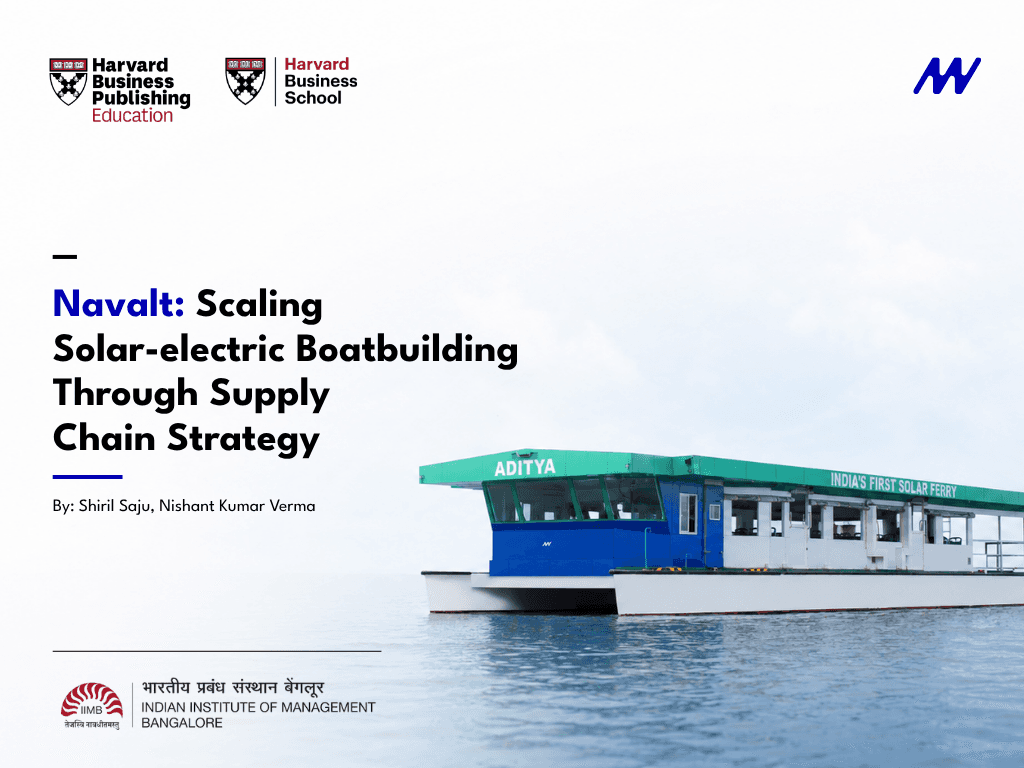
Navalt has been featured in a Harvard Business Publishing teaching case study, Navalt: Scaling Solar-Electric Boatbuilding Through Supply Chain Strategy, published on May 19, 2026. Authored by Shiril Saju and Nishant Kumar Verma of IIM Bangalore, the case is now available through Harvard Business Publishing and the Harvard Business Review Store for use in business schools and executive education programs worldwide.
Navalt didn't start with a business plan. It started with a question why should moving people across water mean noise, exhaust, and fuel costs that never stop climbing? That question, asked on the backwaters of Kerala, led to Aditya, India's first solar-electric public ferry and Aditya led to everything that came after.
This milestone represents more than recognition. It reflects the credibility that Navalt has built over years of solving real problems in an industry undergoing fundamental change.
Why This Story Was Worth Documenting
Harvard Business Publishing teaching cases are selected because they present genuine strategic and operational challenges worth studying. They are designed not to celebrate success but to help students, executives, and entrepreneurs understand the decisions behind it — the trade-offs made, the alternatives considered, and the reasoning that shaped each outcome.
Navalt's journey offered exactly that kind of material. making India's first solar electric passenger boat, Aditya, proved that eco-friendly boat can work. But moving from a single vessel to a growing fleet of solar-electric boats serving diverse applications required something beyond engineering capability. It required Navalt to make a series of difficult operational and strategic decisions about how to structure its manufacturing, manage its supply chain, and scale production without compromising quality or reliability.
Those decisions, and the thinking behind them, form the foundation of the case study.
The Journey from Aditya to a Scaling Manufacturer
When Navalt delivered Aditya, it established that solar-electric propulsion could work reliably in Indian inland waterways. What followed was the harder challenge: building an organization capable of delivering more vessels, faster, across a growing range of applications from passenger ferries to defense, vehicle transport, and larger commercial vessels.
Scaling a hardware-intensive cleantech company requires more than production capacity. It requires rethinking how components are sourced, how supplier relationships are structured, and how manufacturing processes are organized to meet growing demand. These are the real challenges Navalt navigated, and the ones the Harvard Business Publishing case examines in detail.
The case also explores how the capabilities Navalt developed during this phase opened new opportunities including supplying propulsion components to other vessel builders and developing vessel performance analytics through Oceanix, Navalt's software initiative.
What the Industry Can Learn
Marine electrification is no longer a concept. It is a growing commercial reality, and the business challenges it presents supply chain complexity, component certification, manufacturing scale-up, and technology integration are challenges that other companies in this space will face too.
Navalt's experience, now documented in this case, contributes to a broader understanding of how hardware-intensive clean technology companies can scale responsibly. That conversation matters not just within the maritime industry, but across every sector where deep-tech innovation is moving from prototype to production.
Looking Ahead
This milestone is not simply a record of what Navalt has built. It reinforces the company's commitment to the operational discipline, manufacturing capability, and strategic thinking that sustainable marine mobility requires.
As the maritime industry accelerates its transition toward cleaner, smarter transportation, Navalt will continue developing the electric propulsion systems, marine battery technologies, and intelligent vessel solutions that make that transition practical and profitable.
Navalt: Scaling Solar-Electric Boatbuilding Through Supply Chain Strategy (Product #: IM155B-PDF-ENG) is available through Harvard Business Publishing at hbsp.harvard.edu and the Harvard Business Review Store at store.hbr.org.

